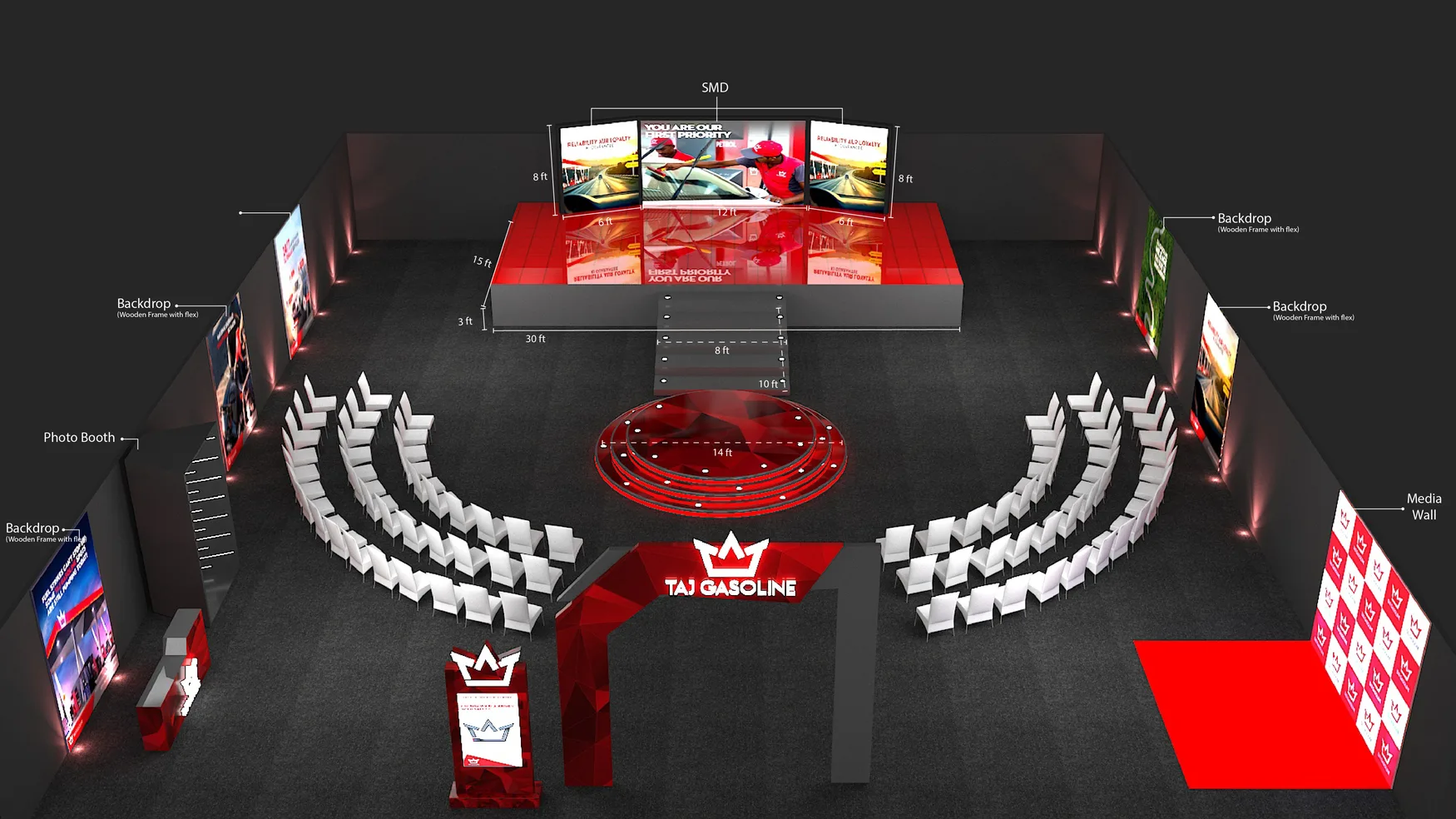
Brand activation is strongest when visitors immediately understand what to do. The spatial design should make the participation journey obvious without relying on lengthy instructions.
Project visuals from Hamza Shah’s supplied portfolio. The editorial text is general design guidance, not a construction specification.
Start with the real constraints
Name the single action you want: try a product, photograph a moment, receive a sample or explore a feature.
Make the visitor experience legible
Design the entry message and interaction point together so visitors are not confused about where to queue or begin.
Coordinate the details
Leave suitable space for staff support, people watching and accessibility; the busiest view is often more revealing than an empty render.
Review the handoff and responsibilities
Choose durable, easy-to-reset graphic and display elements for activations with repeated visitor contact.
How to apply these ideas
Design the entry message and interaction point together so visitors are not confused about where to queue or begin. Choose durable, easy-to-reset graphic and display elements for activations with repeated visitor contact.
Production, engineering, permissions and safety require review by the relevant qualified local parties.
Frequently asked questions
What is the first practical step?
Name the single action you want: try a product, photograph a moment, receive a sample or explore a feature. Design the entry message and interaction point together so visitors are not confused about where to queue or begin.
Can the same approach work internationally?
Production, engineering, permissions and safety require review by the relevant qualified local parties. Exact scope, files, revisions and timings are agreed for each project.
Portfolio references are examples of Hamza Shah’s design work, not evidence that an event was built at a particular venue.
Project visuals from Hamza Shah’s supplied portfolio. The editorial text is general design guidance, not a construction specification.